


Web marketing for e-Commerce sites and online stores
The penetration of online stores in Italy lags surprisingly behind not only northern European countries, but also in comparison with countries closer to us such as France and Spain.
For this very reason, the margins for growth are huge and companies can still find room to successfully enter the online sales market.
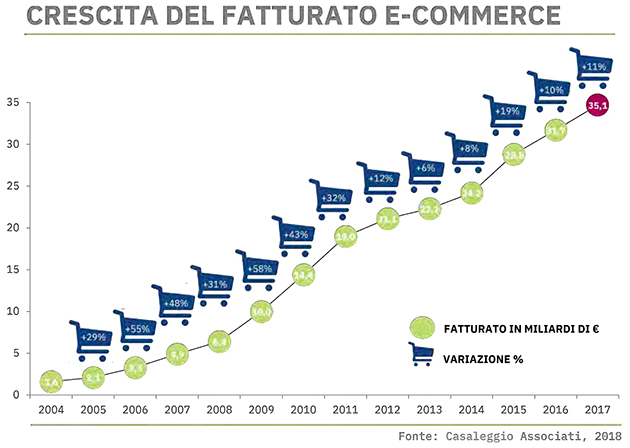
For small and medium-sized enterprises (SMEs), which operate in market niches not dominated by the big e-commerce players (Amazon and eBay above all), the reasons for open an online store are not lacking since in Italy the e-commerce turnover grows at rates of 30 to 50 percent per year until 2011, then declines sharply due in part to the country’s economic difficulties, with the trend remaining significantly upward, however. 2017 marks 11 percent and 2018 looks even better.
The percentage of businesses doing eCommerce in Italy is also growing at a dicisely higher rate than the European average, Eurostat statistics show.
Many SMEs have realized that the eCommerce market represents the future to be conquered by attacking the present and reacting to the bad economy with foresight.
Whether the eCommerce store is already operating online or has yet to be started there are some indispensable elements to consider for sales and web marketing to be successful.
The 6 key qualities for a successful eCommerce site
The success of any business is always the result of a complex of positively contributing factors. For eCommerce stores, the aspects to be taken care of with special attention, excluding financial, logistical and production aspects that are outside the topic of Internet strategy, are six:
- Real and/or perceived value in relation to sale price;
- Ease of use of the site;
- Pleasant navigation and entertainment;
- Inspired confidence and trust;
- Influence of social networks;
- Web marketing strategies.
1. Perceived value versus selling price
On the Internet, unlike in the physical world, comparing product features and prices is very easy, immediate and cost-free: just a few mouse clicks. To be competitive, you need to reduce profit margins on a per-product basis and effectively communicate the added value and advantages offered over the competition. In parallel, it is necessary to work on target users through online marketing to bring visitors inclined to purchase to the site: quality traffic.
2. Ease of use of the site
E-commerce site erases human mediation during the buying process; therefore, it is critical that it always works flawlessly and is easy to use. The purchase funnel, from placing products in the shopping cart to final payment, must be short and require minimal effort. A good Internet store must meet web usability criteria and be accessible for everyone. It is essential that it be suitable for viewing from any device, including tablets and smartphones (mobile site).
3. Pleasant navigation and entertainment
A perfectly functional site can be inadequate in terms of aesthetics, ergonomics and communication. If the navigation experience and content enjoyment are not pleasant and engaging, the likelihood of purchase plummets vertically. Thebuying experience always has an emotional character that site design must take into account. The graphics and design must be pleasing, the information clear, the content stimulating and, why not, entertaining.

4. Confidence and trust inspired
All surveys in the eCommerce industry show that the perception of confidence that the purchase will be successful is a crucial factor in increasing sales. An Internet store must reassure the user through all possible signals. They must be able to contact the merchant by phone, by email and possibly by live chat. It is important to offer transparency in delivery times, cancellation and return rights. Ensure payment security by clearly showing methods and perhaps credit card logos. It all contributes to the conversion of visitor to customer.
5. Influence of social networks
Just as in real life our purchases are influenced by the opinions and recommendations of people we know and don’t know, so online many sales succeed only if they are comforted by the recommendation of acquaintances and consumers. An eCommerce site that integrates social networks and the sharing features they offer certainly has a better chance of success. Similarly, the conversion rate increases with the implementation of systems for collecting user ratings and reviews.
6. Web marketing strategies
The five factors described so far already fall to some extent within the scope of web marketing strategies. More precisely, they can be considered the backbone of ecommerce on which all the particular types of campaigns and tactics that fuel site visits are grafted.
Web marketing for e-commerce sites
Without claiming to want to be exhaustive, in a compendium of the main web marketing strategies for e-commerce sites should certainly be included:
- Competitive analysis and price benchmarking;
- Enhancement of design and user experience on the site;
- SEM – Search Engine Marketing:
- Remarketing and Retargeting;
- Email marketing;
- Social Media Marketing:
- Viral and conversational marketing;
- Integration of social networks on the eCommerce site;
- Implementation of social login;
- Content marketing;
- Affiliate marketing;
- Selling on marketplaces;
- Web Marketing with price comparator sites;
- Web data analysis (data mining).

We defer to other sections of the site the in-depth study of the various types of online marketing as well as the reading of eCommerce data and trends in Italy; here we simply compile a list of tips for increasing online sales.
28 spot tips to boost sales of an eCommerce store
1. Build the site by planning from the beginning at least part of the web marketing activities. Thinking from the beginning about marketing allows you to better define the characteristics that the eCommerce site will have to possess.
2. Include SEO optimization already in the development phase of the eCommerce platform.
3. Try to specialize: generalist portals are the domain of large commercial entities.
4. Develop some distinctive product/service that gives you notoriety in the market. Give it visibility through all web channels.
5. Reduce profit margins on highly competitive products: pricing is a key determinant emphasized by all industry research.
6. Meet delivery deadlines: deviating on this front significantly reduces retention potential.
7. Invest properly in SEO. All visits that come naturally are money saved in other advertising activities.
8. Aim for the “long tail.” Much of the visits from organic search are composed of a wide variety of low occurrence keywords and phrases.
9. There is not only Google, take advantage of all search engines.
10. Use social media to promote the brand and take advantage of word of mouth.
11. Know your target audience, find out what they say about you, analyze sentiment and your online reputation.

12. Create a blog and produce quality content. All the traffic generated reinforces brand reputation and spills over to the eCommerce store.
13. Curate product sheets and focus on high-quality photos.
14. Accept the challenge of product reviews: they encourage purchase and improve search engine rankings.
15. Incentivize the first purchase with a major gift or discount.
16. Use the leverage of discount and promotions to increase transactions.
17. Create bundles and gift boxes, promote cross and up selling to increase average receipt.
18. Invest in email marketing, which often guarantees high conversion rates.
19. Incentivize newsletter subscription by all means.
20. Chase users with remarketing and retargeting.
21. Use the leverage of scarcity and sense of urgency.
22. Encourage impulse buying.
23. Use dynamic pricing technique. Product pricing is the most relevant element for users of online stores. Software exists that monitors prices on other eCommerce sites, offering an excellent real-time benchmarking service. The year Amazon implemented the system, profits grew by 27.2 percent. On Amazon’s site, prices change every 10 minutes.
24. Reduce page load time as much as possible-it can make a difference.
25. Put best-selling products prominently on the home page.
26. Use a system to locate the visitor’s country and reassure them that your eCommerce store also delivers there.
27. Leverage traffic statistics, deeply analyze user behavior on the site, and derive insights to optimize web marketing strategies.
28. Be open to innovations, from year to year new communication and marketing tools are born on the web, eCommerce sites must be the quickest to assimilate them.
In general, to increase online sales, it is crucial to increase the conversion rate, that is, the percentage of visits to the virtual store that turn into eCommerce purchases.

Useful resources on the topic of e-commerce in Italy
www.consorzionetcomm.it
Netcomm Consortium for the growth and spread of e-commerce in Italy
www.aicel.org
National association of e-commerce operators
www.casaleggio.it/e-commerce/
Ranking of the 100 most popular e-commerce sites in Italy (Casaleggio and Associates)
www.istat.it
ISTAT data, information and statistics on e-commerce in Italy
www.pmi.it/tag/e-commerce
Articles on e-commerce for small and medium-sized enterprises