


Online advertising: promoting the company and advertising the site on the Internet
Investment in online advertising continues to grow relative to spending on many other traditional advertising channels such as television and print media.
Between 2017 and 2018, the digital advertising market grew by a remarkable 8 percent, a figure significantly higher than that of other media.
The Italian internet advertising market rose another 2% in the first 5 months of 2019 compared to the previous year, the 2019 report compiled by Nielsen shows:

Advertising on the Internet to publicize a business website or ecommerce store requires a minimum of knowledge of the tools available and the various strategies one can opt for.
To choose the most appropriate advertising strategy, the important aspects to consider are:
- Advertising spaces. The types of advertising space to be purchased on various web channels:
- Search Engines
- Third-party sites, blogs and portals
- Social networks
- Mobile Apps
- Type of ads. Choosing from:
- Textual announcements
- Banner graphics
- Video ads
- Other variations
- Types of campaigns. Simplifying, the 6 macro categories are:
- SEA (Search Engine Advertising). Online advertising on search engines
- Display campaigns. Advertising on third-party sites in the form of:
- Affiliate campaigns or affiliate marketing
- Retargeting
- Remarketing
- RTB (Real Time Bidding)
- Google display
- Native Advertising (Native Advertising). Non-invasive paid ads that respect the look, style and functions of the medium/channel in which they are placed:
- Listings in Marketplaces. Amazon, Etsy, eBay, Alibaba, etc.
- Sponsored Posts and Stories. In Facebook, Instagram, etc.
- Sponsored Articles and Guest Posts. In blogs and online magazines
- Content Recommendations. Natively sponsored content managed by specialized platforms (e.g., Outbrain).
- Social Media Advertising. Promotional ads within social networks with native tools or through contracted intermediaries
- Programmatic Advertising. Based on capturing data via cookies and pixels in order to serve the right advertisement, to the right target, at the right time, automatically. Many of the advertising types listed above can be integrated and managed with programmatic advertising systems
- Price comparators. E-commerce stores post listings of their products on portals specializing in price comparison
- Cost/payment models. The most common are five:
- CPC (Cost Per Click). Better known as Pay per Click, a maximum bid per click is established;
- CPM (Cost per Thousand). That is, cost per thousand impressions;
- CPA (Cost per Acquisition). It is paid when the user takes a certain action on the site or ad (called a performance model for this);
- CPV (Cost per Visitor). The cost per new visit acquired through the advertisement;
- CPV (Cost Per View). The price paid by the advertiser for each new display of the site or ad itself.
This is a schematization that does not reflect the actual complexity and articulation of the tools available, but serves only as an orientation guide for non-experts. Each of these strategies has strengths and weaknesses. The ideal configuration will vary depending on the type of business, the budget available, the goals being set, the target market and other variables.
E-Commerce sites that sell products online take advantage of many types of advertising to capture customers. It is not always easy to identify the best solutions, sometimes proceeding by testing and measuring the results.
It is worthwhile here to elaborate a little on the third point regarding the types of campaigns for those who want to do promotional activities on the Internet for the purpose of publicizing the site or increasing brand awareness on the Web(brand awareness).
Online advertising: types of campaigns
1. SEA – Search Engine Advertising
Since it deals with advertisements on search engines, it falls squarely within the broader purview of SEM (search engine marketing) techniques. The undisputed champion in this area is Google Ads (formerly Adwords) which allows you to advertise on google, but not on other search engines. If you need to run banner ads on Yahoo or Bing you must use Bing Ads. Search engines in Russia or China use other systems still.
Areas where google adwords ads appear in searches
The adwords ads can be text, graphics and video. Only text ads can be published in the google search network and only when users type in the keywords you decided to target in the campaign planning phase.
The most commonly used payment model for adwords ads on the search network is pay per click or CPC (Cost Per Click). Under this system, the advertiser sets a maximum bid with which to participate in the auction to purchase advertising on google and payment is paid only after the user clicks.
The quality of the ad, which Google calculates through Ad Rank and Quality Score, affects the cost of clicks and related percentages (CTR). If an ad runs and receives no clicks, the cost is zero, with the benefit of having still gained a free impression.
Google Ads also allows ads (in various formats) to run on google’s partner sites and portals: those that have become part of its AdSense affiliate network. The choice of contexts in which to show ads is up to the web marketer advertiser, who takes advantage of the geographic, demographic and behavioral variables provided by the system to show ads to potentially more receptive users.
For these reasons, too, a web marketing strategy cannot do without online advertising with Google Ads.
In addition to Google Ads (Adwords) campaigns and its equivalents on other engines, it is possible to advertise directly on search engines through what is known as search retargeting, a type of retargeting that consists of serving targeted advertisements to users who have shown interest in certain subject or merchandise categories on other sites on the network. By grouping users based on browsing habits, search retargeting is a very powerful form of behavioral web marketing that guarantees good performance and a high click through rate (CTR).
2. Display campaigns on third-party sites, blogs and portals
The choice to place ads on these spaces responds primarily to the idea of capturing audiences in contexts deemed consistent with one’s target audience and bringing them to one’s site. A company that sells phone accessories, for example, has every interest in advertising online on portals that sell cell phones.
In the past, the ways in which this advertising technique was exploited were rather artisanal and involved direct contact between the advertiser and the person selling the space. Today, this is mainly done through intermediary companies and digital platforms that manage the matching of supply and demand, as well as the form in which the publication of ads is carried out.
Without wanting to be exhaustive and very schematically, display advertising campaigns include:
- Affiliate campaigns or affiliate marketing. Banner ads, video ads and other types of advertisements (pop-ups, rich media, etc.) are placed in space sold by other websites and web channels called publishers or publishers. The exchange takes place through an intermediary that manages the affiliate program and provides a technology platform that automates the entire process, manages payments and allows monitoring of the campaign. The typical cost model of affiliate marketing is the performance model whereby the intermediary’s fee is paid only when the user performs an action on the advertiser’s site (purchase, submitting a form, viewing a video, etc.).
- Retargeting campaigns. As in the previous case, ads are placed on the web wherever there is a publisher selling a space; the peculiarity of retargeting is that the advertisement is shown only to people who had previously visited the advertiser’s site thus showing some interest. The goals can be to recover unfinalized conversions on the site, propose new buying opportunities to a profiled target audience, strengthen brand awareness.

- Remarketing campaigns. Unlike retargeting in which ads “chase” on the network people who have visited the site without having produced actions of any value, remarketing ads constitute advertising aimed at an audience of customers or people to some extent already involved with the brand. Remarketing campaigns thus aim to build loyalty and strengthen the relationship with the customer. This advertising strategy is not only the preserve of brokerage firms, agencies, and google adwords consultants, but can be carried out on one’s own through email marketing, directly targeting registered users in one’s email database (possibly collected in homogeneous categories).
- RTB or Real Time Bidding. Web marketing model that allows people to buy advertising space by bidding in real time in auctions participated in by multiple advertisers. Originally, auctions were done on unsold, that is, advertising space that had not received bids. Today this model is also being imposed on premium space. Again, this uses specialized intermediaries and platforms that publish on networks of sites affiliated with the program. The advantage of this method is that even niche advertising space can be purchased while spending less than other forms of display marketing. The payment model is CPM (Cost Per Thousand Impressions).
- Google display. We talked about it above: it is the purchase of online advertising space on the sites of google’s proprietary affiliate network (adSense). The platform for running ads is still google adwords.
Since this is an articulated and complex field, variants and other types are added to the display campaigns described, as in the case of search retargeting, which we mentioned earlier, which pursues users directly on search engines and for this reason does not fall under the category of display advertising but should be considered a subcategory of SEA (Search Engine Advertising), itself a specialty of SEM (Search Engine Marketing).
3. Native Advertising (Native Advertising)
Native ads are advertisements that take on the format and tone of the website or web channel where they are published. Publication may, or may not, be automated, in either case the ad (graphic or text) integrates with the rest of the content while maintaining continuity in form and style.
Native advertising is particularly effective because it camouflages itself as normal content within the channel in which it is displayed, greatly decreasing user resistance. In addition, the consistency of style and content it maintains with the flow of the page in which it is placed increases relevance and, with it, the chances of being interesting to the visitor to that web channel.
Native ads appeal to various types of publishers, the main ones being:
- Marketplace: Amazon, eBay, Alibaba, Etsy, etc.
- Social Media: Facebook, Youtube, Instagram, LinkedIn, etc.
- Blog and Online Magazine
4. Social media advertising: advertising in social channels
If social media marketing is the strategic use of social channels and online communities for commercial purposes, social network advertising is paid advertising displayed within social networks. It is a very interesting option and increasingly exploited by companies because it allows them to leverage the precipitous features of each social network to capture the attention of the audience: engaging them in actions within those channels, leading them to visit the website or the physical stores themselves with coupons issued through advertising campaign.
The main advantage of online advertising on social networks is to be able to leverage geographic, demographic, and psychographic information provided by the users themselves, or inferred from their activity within the channels, to package display ads aimed at a highly profiled target audience.
The most important social channels in which one can advertise online in Italy with good margins of success are:
- Youtube
For each of these popular social networks, the in-channel ad management interface offers specific features that are continually updated to provide advertisers with new options and greater potential for return on investment.
Ad formats vary by channel and can be text, graphics, video, or particular variations of these. Typical cost models are Pay Per Click (CPC) and Cost Per Thousand (CPM). All social channels provide more or less sophisticated tracking data to measure campaign performance. It is recommended to compare them, when needed, with those obtained from website monitoring to derive useful interpretations for campaign optimization and ROI quantification.
Recall that the companies specializing in retargeting campaigns we mentioned earlier sometimes offer the possibility of retargeting on social networks in addition to other website circuits. This is possible thanks to multilateral agreements between social networks and these online advertising intermediaries. In this way, social networks become part of the retargeting circuits, offering an additional opportunity to chase web users with banner ads.
In general, social media advertising is a rapidly developing branch of online advertising that promises to absorb increasing shares of Internet advertising budgets allocated by companies (not only b2c) of all sizes.
5. Programmatic Advertising (Programmatic Advertising)
Programmatic advertising is a type of automated advertising run by programs that specialize in buying and selling advertising space on sites, Internet platforms, and digital applications (not just mobile).
Ads can be text, video or graphic banners, and are published in real time as a result of the interaction between advertisers (advertisers) and publishers (publishers) through the use of automated computer platforms.
In this respect, programmatic advertising is a form of online advertising similar to RTB (Real Time Bidding), the difference, which then is the great strength of programmatic advertising, is that the latter makes use of the data “affixed” to users, thanks to cookies and pixels, to serve ads more appropriately and effectively.
When we browse the Internet, with the browser of our computer or smartphone, when we use facebook or other social networks, when we use whatsapp to communicate with friends, when we download a mobile app, and so on, our actions are recorded and associated (cookies and pixels) with the software and applications we use on the Net, as labels that “declare” to other specialized software what our user profile is (where we live, who and what places we frequent, habits, tastes, spending capacity, etc.).
Demographic and behavioral data about us become information used to serve us targeted advertisements:
- The right announcement: in terms of content and proposal
- In the right digital channel: in terms of consistency and relevance to the proposed content
- At the right time: with the right timing
- in the right virtual or physical place: the advertisement can be posted on a thematic web portal or, for example, it can appear on a digital panel inside a physical store
The technical operation of this real-time buying and selling system is relatively complex and calls into question 5 types of technology platforms:
- DMP (Data Management Platform): collects and organizes big data related to user behavior, segmenting it into categories and turning it into useful information for advertisers to identify the type of audience they are interested in;
- DSP (Demand Side Platform): participate in the real-time auction process by inputting information about advertisers and their buying needs (budget, bid settings, target user profiles, etc.);
- SSP (Sell Side Platform): create the inventory of advertising space auctioned by publishers in different media;
- AD Exchange: is the platform that connects DSPs, or advertisers, with SSPs, or publishers, allowing supply and demand to meet in the online marketplace.
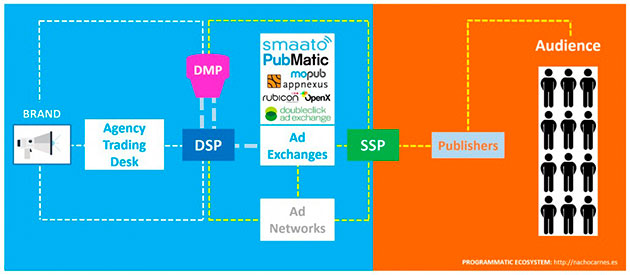
In summary, programmatic advertising allows you to buy ad space programmatically by switching from planning by impressions to planning by person, with a higher level of targeting than classic RTB.
A banner can then be published in web channels, mobile applications or digital platforms that are editorially consistent with the planned campaign, for a specific target audience, at a specific time, in a specific geographic location, on a specific device.
Therefore, at present, programmatic advertising can be considered the most advanced form of real-time advertising.
6. Listings on price comparison sites
This advertising option is reserved for e-commerce stores that sell online. By affiliating with price comparator sites, one’s product catalog is entered into the portal’s database and becomes accessible through internal site searches but also among search engine results, gaining visibility on the Internet.
Price comparators do not sell directly, rather, depending on the searches made, they show a list of products of the same commodity type but from different sellers comparing their prices and other characteristics in order to make the work easier for users. Listings posted are accompanied by product photos, prices, and descriptions that the seller provides to the portal to promote its catalog. Once clicked, the listings lead the user to the relevant page of the online store where the purchase can be made.
Advertising the online store with price comparators procures an important source of visitors to the eCommerce site and provides increased visibility on the Web. Stores that are not afraid to compare themselves with competitors take advantage of this promotional technique to boost online sales and increase brand awareness.

Conclusions
As you can guess from this concise guide, the field of Internet advertising is extremely diverse and continues to expand in newer and more sophisticated forms. Each type of advertising is handled by specialized companies and professionals who usually follow and support the client. In order to untangle this multifaceted reality, it is necessary to have someone in the company who oversees the various advertising activities or to rely on a web marketing consultant who knows how to direct and preside over this market sector.
It does not pause to emphasize that before embarking on advertising campaigns to promote the website one should verify that the latter meets the standards of accessibility and usability that make it functional and effective with respect to the objectives of the advertising campaign.
Even better if you start early SEO optimization interventions of the site to achieve good web ranking.
Last but not least, one must equip websites with monitoring tools such as Google Analytics in order to be able to measure the performance of various web advertising activities, analyze site access data and the performance of online campaigns.
This work must be done upstream of all other initiatives.