


Social Media Marketing: social networks and online communities serving businesses
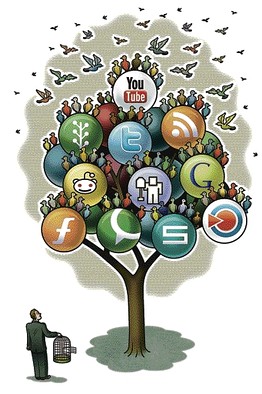
Social media marketing is a specialty of web marketing. In order to give a comprehensive definition of it, it is necessary to state that it is a broader concept than social network marketing: the latter specifically refers to unconventional marketing activities carried out through social networks such as facebook and twitter; social media marketing broadens the use of promotional techniques to include the entire variety of social channels on the web, including in addition to social networks blogs, forums and other forms of online communities that fall under the broad category of social media.
Social media marketing is a tool available to companies to promote their businesses on the web and sell products and services online. To understand the potential of this form of marketing that invests the Internet, it is useful to break it down into its basic aspects or techniques:
Social CRM and online relationship marketing
As the Cluetrain Manifesto taught us: markets are conversations. A thesis or social reality that sees conversation as the social lubricant that runs through human relationships from the design of goods and services to the sale and beyond. Truth made more evident and pervasive by the Web and the spread of social media.
If markets are conversations, firms that do not converse become invisible. They lose contact with their interlocutors.

Especially on social media, to converse means to enter into a dialogical relationship with customers in order to manage the relationship to satisfy and retain them. In this sense, social media marketing is the transposition to social channels of the:
- relationship marketing. That is, of the marketing technique that aims to increase the value of customer relationships;
- CRM (customer relationship management) or customer relationship management.
Relationship marketing represents an outgrowth of traditional marketing. The latter was concerned with customers in terms of large aggregates through the analysis of mass consumption data. Relationship marketing, on the other hand, in an era of personalization of products and services, recovers the centrality of the customer by establishing a one-to-one relationship and putting the brand in a direct and dynamic relationship with its target audience.
Before the development of the web network, this relational model was limited by the dominance of essentially unidirectional media (such as television and radio), which did not allow the construction of bidirectional and horizontal relationships. Today, especially thanks to the success of social networks and other social channels, we are witnessing the overcoming of the unidirectional and vertical model of the relationship in favor of a more equal model that restores the customer to an active role in the business affair.
The way social media works forces companies to listen to their online fans, to involve them in business activities and decisions, and to support them with worthy customer service. This horizontal relationship is a necessity dictated by the medium (the medium is the message said McLuhan), but it is also a great opportunity to get to know one’s customers and build their loyalty by offering online service that is value-added in the business relationship.
Through social media, businesses have the opportunity to receive comments on their operations, feedback on services and products, even advice or ideas for improvement. Of course, there is a risk of becoming the subject of criticism, but this risk should be addressed with a complaints and grievance management plan.
The best strategy is to accept the challenge, respond promptly to inquiries, welcome criticism and remedy it with concrete actions, and make up for any inconvenience caused with compensatory actions that highlight on social media the attention and care the company pays to its customers. By this route, the risks of negative consequences for corporate image are converted into marketing opportunities and online reputation building.

Social CRM therefore means being able to offer post-sales support, but also, when necessary, conduct sales negotiations, identify new contacts and potential customers, do PR work and develop sales initiatives. Social media offer enormous opportunities: one has to think about how to exploit them on a case-by-case basis, depending on the goals and characteristics of the business.
A proprietary blog makes it possible to activate a direct channel of communication with users and to engage in content marketing activities – content marketing and blog marketing – with particularly positive effects for SEO as well; the world of blogs in general offers the opportunity to make oneself known through direct interventions and comments on articles or through explicit business deals; forums constitute online communities to which one can offer a contribution of participation through one’s company profile, gaining in reputation and authority.
When these strategies are implemented effectively, several business goals are achieved:
- Promote brand awareness;
- create an online community of admirers active in promoting one’s brand and activities, of spokespeople inclined to extol the qualities of one’s products and services;
- Build new sources of traffic to one’s website, increasing targeted visits.
Relationship web marketing and social CRM lay the foundation for the viral success of a brand’s social initiatives.
Viral marketing or buzz marketing
Viral marketing is also referred to as conversational marketing, fitting neatly into the conception of markets as conversations. Thegoal of viral marketing is to harness the power of word of mouth to increase the volume of conversations related to a product or service so as to increase its appreciation by a broad audience of consumers who are on target with the commercial offering.
The term “viral” recalls the way viruses are spread: by contamination and transmission. Similarly in English the word “buzz” is also used, among other things very onomatopoeic, referring to the “buzzing” of bees and the ability to target “swarms,” that is, groups of people homogeneous in interests and tastes with respect to certain types of products/services.
In this sense, viral marketing or buzz marketing constitutes the set of strategies that leverage the active role played by users in social media, consciously or unconsciously, spontaneously or on incentive, to spread content created by companies and their social media marketing consultants.
Social networks, blogs, forums, photo and video sharing environments, communities of interest, wiki websites, and so on, constitute environments where conversations take place to be influenced by one’s speech. This is the challenge for businesses: to create content with characteristics such that it becomes an object of conversation, of word of mouth, quality content that arouses in users the desire to share.
When this is achieved, viral marketing shows its full potential by allowing businesses not only to promote the individual product or service, but also to gain notoriety and reputation. This is why viral marketing is also a great way to do branding.
The logic of virality also presents its own ghosts to chase away when it rages against the company instead of in its favor. Consider the Barilla case and the amount of critical conversations it generated on social channels following Guido Barilla’s ill-fated interview.
As is evident from the two examples above, the main tool of viral marketing is video, which in these cases becomes viral video marketing. Examples of social media marketing that exploit the viral potential of video are endless and not necessarily promoted by private companies.
Anti-smoking campaign promoted by Thai health promotion foundation Thai Health Promotion
Advertising on social networks or Social Network Advertising
Social Network Advertising is a form of online advertising that involves placing ads and banner ads within social networks in order to:
- Promote products or services;
- Increase brandawareness (brand awareness);
- Advertise the website;
- Giving visibility to their social channels;
- Send users to physical stores to take advantage of discounts and promotional coupons.
Since it is a marketing technique that takes advantage of the specific logic of each social network where the advertisements are posted, it is also referred to as native advertising or native advertising.
Social media advertising is a very attractive solution for a number of reasons:
- Is not intrusive. By inserting itself natively within the flow of information and conversations proper to the selected media, it is unobtrusive and often even welcome;
- allows target identification unthinkable with generalist media such as radio and television. With data provided by the users themselves and data gleaned from their behavior within social networks, one has demographic, geographic and psychographic variables that are extraordinarily useful for targeted advertising campaign planning;
- is perfectly measurable through tracking systems provided by the social networks themselves natively and with other systems depending on where the traffic generated by the ads is funneled;
- allows almost immediate analysis of results with the ability to make running adjustments (fine tuning).
For advertising within social networks to be successful, it must know how to exploit its functional and audience characteristics, possibly coordinating with other activities carried out on the social networks themselves and more generally online.
Ad formats vary depending on the social network and goals; they can be:
- TEXT;
- charts;
- video;
- other variants.
The most common payment models are Pay Per Click (CPC) and Cost Per Thousand (CPM).
The social channels that currently offer the best advertising opportunities are:
- youtube
Banner ads can refer the user to an internal social network page or directly to the website. In e-commerce, it is almost always preferred to refer back to the site where visits can be immediately converted into sales.
Identifying the most appropriate strategy for advertising on social is the job of the social media marketing specialist. There are also companies specializing in retargeting campaigns that post banners on social networks with which they have partnership agreements.
SMO - Social Media Optimisation
SMO is a specialty of social media marketing that involvesoptimizing social channels, particularly social networks, to make them more visible on search engines with positive effects on the ranking of related websites as well.
In essence, it is a mirror activity of SEO, but instead of being carried out to improve the indexing and ranking of website pages, it aims to achieve the same results on social media and indirectly also on the sites to which these are linked.
The need to invest in social media optimization stems from the way search engines work. These determine the ranking of websites according to their relevance and relevance to the keywords used by users. This evaluation is done through programs based on mathematical algorithms (the most famous is Google’s Page Rank and subsequent reinforcements: Panda, Penguin, Hummingbird), which make use of hundreds of different factors including, very important, backlinks and social signals.
Backlinks are inbound links from other sites (including social networks, blogs, forums, etc.) and in the eyes of search engine spiders are a testament to the validity of the content of the site to which they refer.
Social signals are indicators that measure the relevance of the social channels they originate from and the content circulating in them:
- Subscribers (youtube channel registrations e.g.);
- Likes (+1 on google plus or “like” on facebook);
- Shares (retweets on twitter);
- Engagement (comments on a blog or linkedin post).
As search engines measure these signals to determine the prominence of one site or social channel over another, it becomes important to enhance one’s social media by making them more appealing and compliant with current indexing criteria.

Therefore,SMO optimization aims to provide engine spiders with all the information they need to increase the visibility and ranking of social sites in the results of Google, Yahoo, Bing and so on. Through the inclusion of appropriate tags in posts or keywords in domain urls, for example, one’s social channels gain positions, gain fans, increase the volume of interactions, and this produces a positive circular effect that benefits social media directly and sites linked to them indirectly.
Today, an SEO campaign for the corporate site should always be complemented by SMO interventions of social media optimization linked to the site.
Like SEO, social media optimization is also most effective when carried out during the creation phase of the site and company profiles on social networks.
An excellent social media marketing plan incorporates an SMO strategy from the outset, to be included in the broader horizon of an SEM strategy attentive to the logic of search engine operations.
Social monitoring and analysis
A comprehensive social media marketing activity should always include a system for data collection and analysis of results. The three important operations to plan are:
- Measuring;
- Analyzing and Interpreting;
- Rework.

Measuring means setting up a system to monitor marketing activities carried out on social media. The most advanced social networks offer within their platforms very useful tools for monitoring ordinary activity and advertising campaigns. Activating web analytics tools for the site, such as Google Analytics, allow you to collect data and statistics on the traffic that spills over from social media to the company site.
Analyzing and interpreting involves considerable effort to test the assumptions behind the marketing strategies adopted by obtaining confirmation or disconfirmation. Identifying patterns and recurrences, interaction patterns, precise cause-and-effect relationships, allows one to better understand the target market of one’s initiatives.
Reprocessing means converting accumulated data into expendable information to correct or redefine web marketing and social media marketing strategies.
When a company can leverage the data it collects as a business lever, it is on the right path to success.
Consulting on social media marketing
The variety of social channels and marketing strategies that can be activated is such that sometimes even a social media specialist is not enough but a dedicated team and high spending budgets would be needed to be able to plan and manage promotional communication on the web.
This solution for many small and medium-sized companies is not pursuable or necessary very often.
A web marketing plan, or more narrowly social media marketing plan, should therefore identify priorities according to the budget and resources available, possibly with an eye to the future that includes the possibility of an escalation of online marketing initiatives in the wake of successes.